
How to Curl Hair for Photoshoots -Ulimate Guide
Learn how to curl hair for photoshoots using professional techniques that create definition, balance, and long-lasting curls that photograph beautifully.
Hairstyling for a photoshoot is very different from everyday styling. I’ve learned that styles which look fine in real life can appear flat, unbalanced, or messy on camera, even when created with a curling iron. Lighting, angles, and movement change how curls appear in photos. What looks like too much hair in person may look just right on screen. That’s why photoshoot styling must be more deliberate—guesswork rarely works when a camera is involved.
To know how to use curls in photoshoots, one has to know how curls can be read visually. The stylists are professionals who are concerned about shape, balance, and durability not just comfort. Curls have to contain under lights, motion, and time. They must also be able to position the face in the right position in various angles. This paper describes the process of creating camera-ready curls that appear to be smooth, three-dimensional, and realistic on the screen. The aim is curls which are photographed in a natural manner without appearing to be hard and unnatural.
Why Curls Look Different on Camera
The cameras are flat and minimize texture. What is voluminous in life might make it in pictures softer or flatter. Subtle waves are also washed out by lighting. That is why curls tend to require additional definition in case of photoshoots. The camera demands clarity.
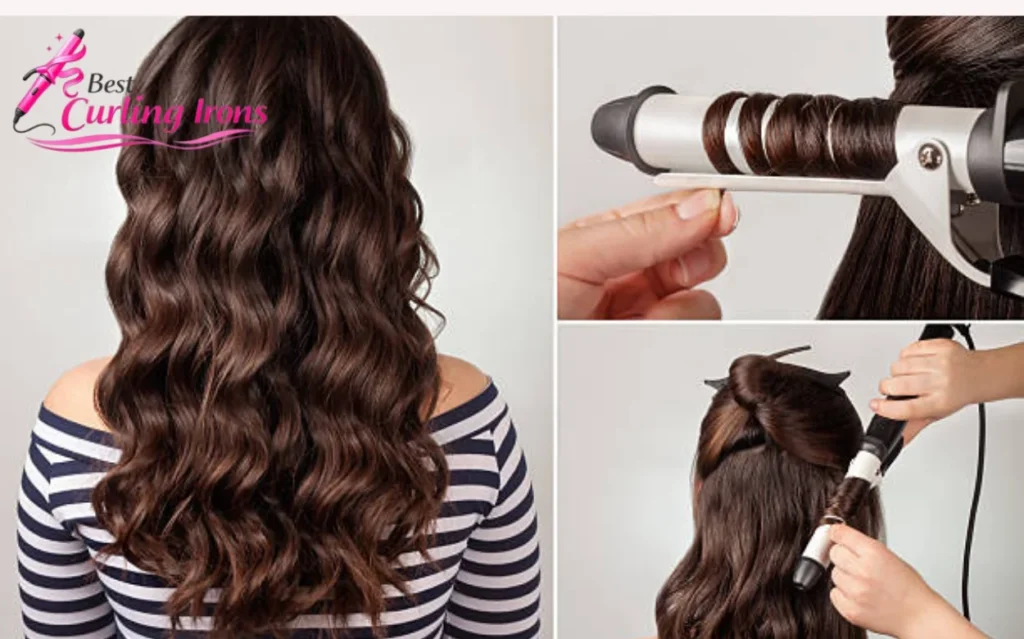
I have observed that photographers usually demand more wavy hair than it ought to be. It is not exaggeration but it is compensation. The lens absorbs detail. This can be understood to avoid under-styling. Curls will have to be camera conscious. That knowledge makes you have a different attitude towards curling altogether.
Starting With the Right Hair Condition
How curls are photographed is dependent on the condition of hair. Exceedingly greasy hair is uneven at reflecting light. Excessively dry hair is frizzed and broken. Bath hair is best photographed. Well groomed hair is clean and well prepared and reflects the light evenly.
Professionally, it is experience to create hair that is not greasy, but healthy. Excessive softness will make curls fall. Excessive dryness presents the problem of texture on the camera. Owing to the shoots, conditioning is set adjustingly. The setting of the visual base is done by hair preparation.
Sectioning for Camera Balance
Photoshoot sectioning is not as spontaneous as daily dressing. The sections will be designed to form symmetry and flow. Lack of balance in the camera can be a result of uneven sectioning. Face shape and angles are some of the sections that can be mapped out by professionals.
I have observed that intelligent partitioning enhances uniformity amongst photographs. The hair falls in all directions, in one way. This minimizes the use of continual touch-ups. Sectioning regulates the volume and movement. It is a non-verbal but mighty styling device.
Choosing the Right Barrel Size
The visual reading of the curls is dependent on the barrel size. The barrels are very tiny and cause tight curls which can appear as busy on the camera. Barrels of very large size can vanish in light. The best definition is normally made by medium barrels. They are not rigid in their form.
Personally, I have realized that the professionals determine the amount of barrel size depending on the need of framing. A section of the face-frame can have a little smaller barrels. Larger ones may be utilized in the back. This variation adds depth. The issue of barrel choice is not homogeneity, but rather visual balance.
Curl Direction for Dimension
Direction of curls gives dimension to photos. When everything is curled in the same manner it may appear flat on the camera. The practitioners switch directions in an unobtrusive way. This brings separation and shadow. Photography cannot exist without dimension.
I have noticed that the curls become even more dynamic when the direction is not accidental. Away-from-face curls open up the face. The mixed direction eliminates clumping. Direction determines the way in which the hair is struck with light. This effect gives photos alive attributes.
Heat Control for Defined Yet Soft Curls
The Photoshoot curls must be able to hold, yet they should not appear to be stiff. Too much heat causes hard curls which reflect the light inefficiently. Moving heat does not affect flexibility. The soft curls are more efficient in camera. The shape should not be frozen by the heat, it should be supported.
Professionally, we can use experience that teaches us, and there is more of technique than temperature. Curls that are long term are made possible through controlled heat and timing. Flattening of texture with time is brought about by overheating. Even heat does not have overload of shine.
Timing for Long-Lasting Results
The duration of the lastability of curls during the shoot depends on timing. Taking hair too short will produce weak curls which will fall very fast. The stiffness comes about by holding too long. Hair response is observed by the professionals. The timing is set on a section-by-section basis.
I have observed that ends take less time than the middle parts. Curls are vintage on film, as they are overheld. Even time brings about uniformity. Timely treatment minimizes the touch-ups. This will save time at the shoot.
Cooling Curls for Camera Hold
Photoshoot styling is important in cooling. Curls have to be allowed to cool to set. Premature touching of curls destroys structure. Curls are usually left to cool down or they are cut off by professionals. Cooling defines itself appropriately.
In my experience, the curls that cool properly take more time before they run out of light. They possess by gesturing and posturing. Cooling also enhances uniformity of the head. Constant fixing in the future is substituted by patience here. The process of forming the curl is finished by cooling.
Creating Root Support Without Over-Volume
Photoshoot curls must not be bulky. Excessive amount of volume may overwhelm the face. Excessively little flattens hair. Root support is created unintentionally by professionals. Lift is manipulated and positioned.
I have observed that it is angle and sectioning that makes the camera friendly and not teasing. The face must be surrounded by hair. Root support must be unnoticeable. It is what is in balance than height. Photographs to do best are controlled lifts.
Breaking Curls for a Natural Finish
Curls are not left in their natural form to be photographed. They are softened by being crushed by professionals. Instead of brushes, fingers are used. This maintains definition and has a flow. Excessive brushing kills the camera detail.
Selective breaking of curls is the most effective. There are those curls that remain defined due to structure. Others are made soft in order to move. This mix creates realism. This is not a perfected goal. Manageable flaws are a great idea to photograph.
Finishing for Shine and Control
Final products must add texture but not satirate hair. Light is unevenly reflected on heavy products. The minimal finishing is used by professionals, and it may pay attention to ends. Roots are kept clean. Less is more for camera work.
I have observed that it is better to take back before completing it, otherwise one tends to overdo it. A large number of curls will settle out of shape. Light refinement is enough. The finishing must not overrule the style. Hair that is camera-ready is never hard.
Avoiding Common Photoshoot Curling Mistakes
One of the typical errors is under-curling since the hair appears to be too curly in reality. The other one is excessive use of product to force hold. The camera is a good display of these errors. Hair is killed by overworking.

I have observed professionals who have confidence in the process rather than make changes continuously. The style of camera work must be kept back. Correcting an excess eliminates equilibrium. These errors can be avoided in order to enhance consistency between shots. Better results are achieved through awareness.
Practicing for Consistent Camera Results
The art of curling photoshoots is developed through training and feedback. After that, professionals learn how to make hair look in photos. Revisions are done in further shoots. The practice develops visual cognition. The process of styling is more deliberate.
Personally, I have found that more can be learned through looking at photos than through mirrors. You get to know where volume and where definition is. Experience creates awareness of the camera. In the long run, curls are predictable and dependable. Repetitions bring about consistency.
FAQs About How to Curl Hair for Photoshoots
Conclusion
Photoshoot hair styling takes more planning than normal hair styling. Comfort is not the most important thing, definition, balance and durability are. Direction, heat, sectioning, and cooling are involved. The curls are to be constructed to pass through the lens. Guesswork is substituted by technique.
In my experience, softness is controlled to make the best photoshoot curls. They are muscular and not rigid and move with natural motion. Any person can get camera ready curls with practice and awareness. It is not about dressing in front of a mirror, but a camera. Considerable skill provides professional outcomes.