Can Curling Irons Damage Bathroom Counters? – Guide
Learn Can Curling Irons Damage Bathroom Counters ,which surfaces are most at risk, and simple ways to protect your vanity from heat marks and burns.
A lot of individuals put their curling irons on the counter tops of bathrooms without a second thought. I would always do that curl my hair, put down the iron and walk out. This gradually appeared in the form of odd spots, dark patches, and even dark spots in the shape of burn spots on my counter. Initially, I thought that it was regular wear when it was not.
Curling irons can indeed damage bathroom counters, especially when a curling iron is hot or placed repeatedly in the same spot. The good news is that this type of damage is completely avoidable. By understanding how heat affects different surfaces and taking simple preventive steps, you can protect your counters and keep your bathroom looking new while still using your curling iron safely.
Fast Facts
The average curling iron has temperatures ranging between 300 C degrees to 450 C degrees, which is sufficient to destroy most countertop materials. Personally, I have observed laminate blisters, acrylic warp and sealed wood discoloring after a short experience with a hot iron.
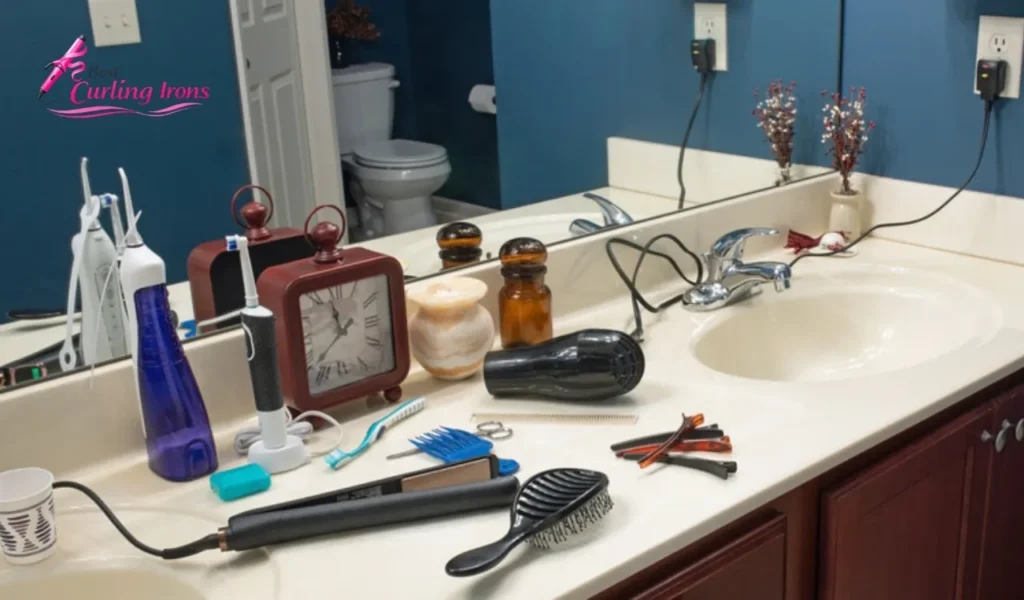
Marble or quartz surfaces are more resistant to heat, however, they are not resistant. Expertise: Exposure to sealants may make them weaker, dull, and crack with time. A heat resistant mat or holder would minimize such dangers significantly.
How Curling Iron Heat Affects Surfaces
Metal barrels are also very fast in heat transfers. I found that when I had the hot iron on a laminate counter, I had accidentally left it and the following day I noticed a low-order ring. That was not left by a burn–that was left by the fact that the material had softened a little and been remodelled by heat.
There are those surfaces that absorb heat and there are those that reflect. Surfaces that are absorbing such as wood or a counter made of plastic are said to be more susceptible to warping or discolouring. Reflective surfaces do not necessarily burn, however, the surface surface can be damaged in the long-term due to the degradation of the finish or seal.
Types of Bathroom Counters and Their Risk Levels
Counter reactions are not always similar. One of the weakest materials is laminate. I have even observed it bubbling, peeling and fading with only a few seconds of direct heat. When laminate is destroyed, it is almost impossible to repair it invisibly.
Natural materials such as granite or marble are more heat resistant although repeated heating compromises sealants. Quartz counters may have resin that may discolour when subjected to high temperatures or even crack. Tiles grout even can turn dark or disintegrate.
Why Even Short Contact Can Cause Damage
Society believes that the only way people get damaged is by leaving something on a hot surface over a long period of time. As a matter of fact, even short-time contact may result in problems. I had once placed my curling iron down and waited less than ten seconds and then I felt a faint spot.
This is due to the fact that curling irons become hot within a short period and the heat is reflected straight to the underlying heat. Materials also swell when subjected to heat and upon cooling they do not necessarily regain their shape. That is the way that warping, dull patches, and cracks are created.
Long-Term Damage from Repeated Heat Exposure
A single exposure may not cause any apparent harm, however, with repeated exposure, it frequently results in harm. I have observed that where I used my iron on many occasions, it got dull and uneven with time though there was no particular incidence that appeared serious.
Stresses on materials are due to repeated heating and cooling. Sealants dry, resins become weak and the cracks develop on a microscopic level. In months, this accumulates to noticeable wear that appears to be irreversible. This is the reason why repairing is less important than prevention.
How Moisture Makes the Damage Worse
Bathrooms are damp. Moisture makes most materials pliable and thus damageable by heat. I did not know till the time when I noticed my counter changing the color more in summer when it was more humid.
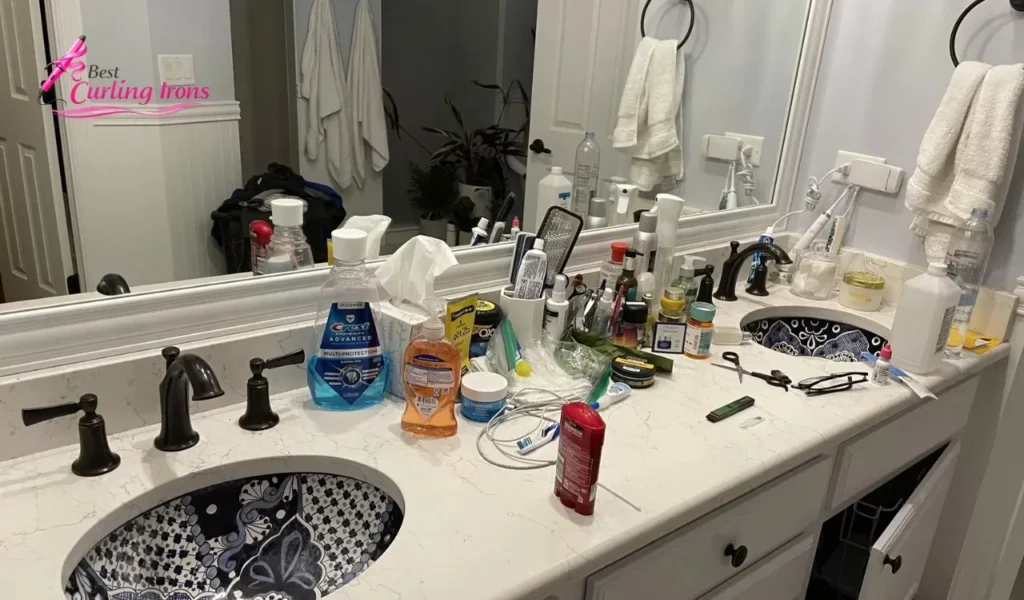
When moisture is combined with heat, it increases surface deterioration. Sealants deteriorate more quickly, wood expands and material composed of plastics become more elastic. This is why it is more dangerous to put hot tools on the bathroom counters as opposed to dry ones.
Signs Your Counter Has Been Damaged
Initially, heat damage can manifest itself in dull spots, faint rings, slight discolouration or altered texture. I have observed the fact that there were few areas which were rougher or less glossy than the rest.
Severe injuries consist of blistering, cracking, bubbling, or stains that are permanent. As soon as you have seen these, it is hard to mend. When you notice the first signs it is possible to modify the habits before it is too late.
Common Mistakes People Make
The biggest mistake is to believe that counters are heat-safe. I used to believe that stone meant that it was indestructible and this is not the case. The majority of countertops are covered either with materials that are difficult to react to high temperatures or they are bonded.
The next error is putting the curling irons on the floor yet they are still warming. Most of the irons get hot at a fast rate thus a couple of seconds can be sufficient to ruin them. Lack of a protective barrier is one of the largest causes.
Simple Ways to Protect Your Counters
The simplest remedy is with the help of a heat-resistant mat. I have one of them next to my bathroom mirror, and it has totally revolutionized my routine. The pads are heat absorbing and they do not touch the counter.
Silicone pads, ceramic trays and metal stands are also helpful. There are even curling irons that have stands or safety tips. Any obstacle between the radiant barrel and your counter is a big difference.
When Counter Damage Becomes Permanent
Minor marks may go, but deeper heat damage is not normally destroyed. After the surface structure has been altered, it cannot be repaired by polishing or cleaning. I found this the hard way when I attempted to rub a burn ring out.
Dendritic damage is usually permanent and needs to be resurfaced or changed. That is an expensive and unnecessary thing with preventive measures being easy. Even the slightest change of habit will cost much less.
FAQs: Can Curling Irons Damage Bathroom Counters
Final Thoughts
Curling irons have the potential to definitely damage bathroom counters and it happens unobtrusively with time. I would consider myself being cautious but little things such as where I kept my iron mattered.
You do not have to make extensive changes in protecting your counters. Heat mat, improved cooling behavior and knowledge about the surface material will go far. These habits will not even enter your head once you start doing them, and your bathroom will remain clean and fresh.